Dramatic Classic vs Classic: Which Kibbe Type Are You?
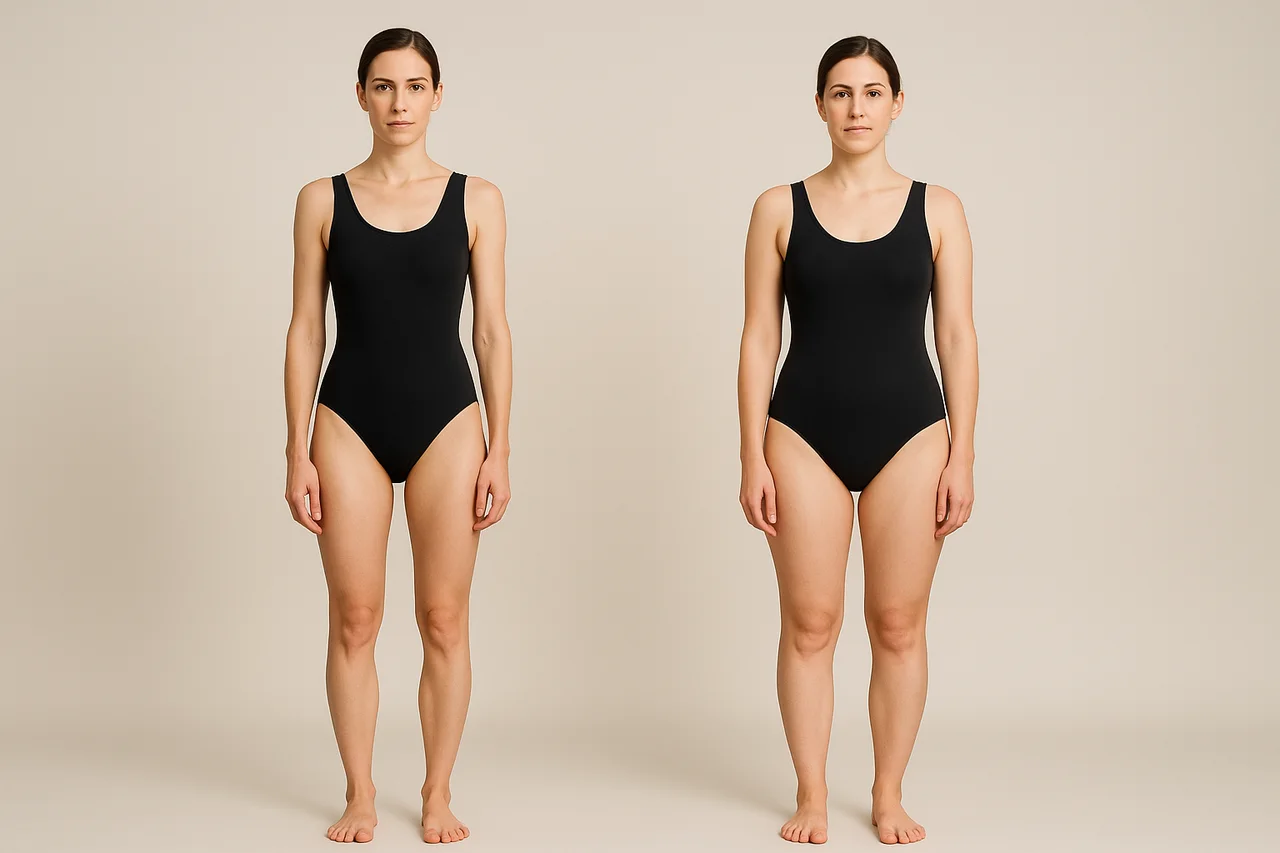
Dramatic Classic and Classic share the same balanced foundation — neither type runs to an extreme in either direction. What separates them is how much angularity sits on top of that balance. Classic stays narrow and evenly symmetrical throughout. Dramatic Classic carries the same overall balance but with visibly squarer, more angular edges at the shoulder, jaw, and hands.
Dramatic Classic tells
- Your shoulders, jawline, hands, and feet all read a little square or angular rather than softly tapered.
- Your facial structure has a more defined, sculpted quality to it.
- Weight tends to show up quickly and settle from the waist down.
- People often describe you as polished with an edge, or elegantly commanding.
- Your eyes and lips stay moderate in size — the sharpness here comes from bone structure, not facial features.
Classic tells
- Your shoulders, jawline, hands, and feet stay narrow and evenly proportioned, without a squared quality.
- Your facial structure is chiseled but fully symmetrical, with no particular angle standing out.
- Your build stays even and proportionate at most weights.
- People often describe you as classically elegant or simply well put-together.
- Your eyes and lips read moderate, matching the same even scale as the rest of your face.
Both types share the same essentially balanced, non-extreme foundation, which is why the confusion happens even among people who know their own proportions fairly well. The clearest signal isn’t the overall impression but the specific edges — shoulders, jaw, hands, feet — since a squarer quality in any of those spots is the one thing a fully symmetrical Classic frame won’t have.
The deciding questions
- Are your shoulders and jawline noticeably square, or narrow and tapered? Square points to Dramatic Classic; narrow and tapered points to Classic.
- Do your hands and feet read as a little squarish, or as slender and moderate? Squarish leans Dramatic Classic; slender leans Classic.
- Does your face have one sculpted, angular feature that stands out, or does it read as fully even and symmetrical? A standout angle points to Dramatic Classic; full evenness points to Classic.
Let the scoring settle it. Take the quiz — 16 questions, real scoring, no email wall.
Read the full profiles at the Dramatic Classic hub and the Classic hub.
Quick answers
What’s the single biggest difference between Dramatic Classic and Classic?
Angularity — Dramatic Classic carries a squarer edge at the shoulders, jaw, hands, and feet, while Classic stays narrow and fully symmetrical throughout.
Does weight distribution help distinguish them?
A little — Dramatic Classic tends to show weight gain from the waist down first, while Classic stays even and proportionate at most weights.
What about the face?
Dramatic Classic’s face has a more sculpted, defined quality, while Classic’s face is chiseled but fully symmetrical with no standout angle.
Unofficial guide inspired by the Image Identity system in David Kibbe’s Metamorphosis (1987). Body types describe line, not worth — every type is the goal, not a consolation prize.