Dramatic Classic Makeup Guide
Classic family · Makeup
The Sculpted Face
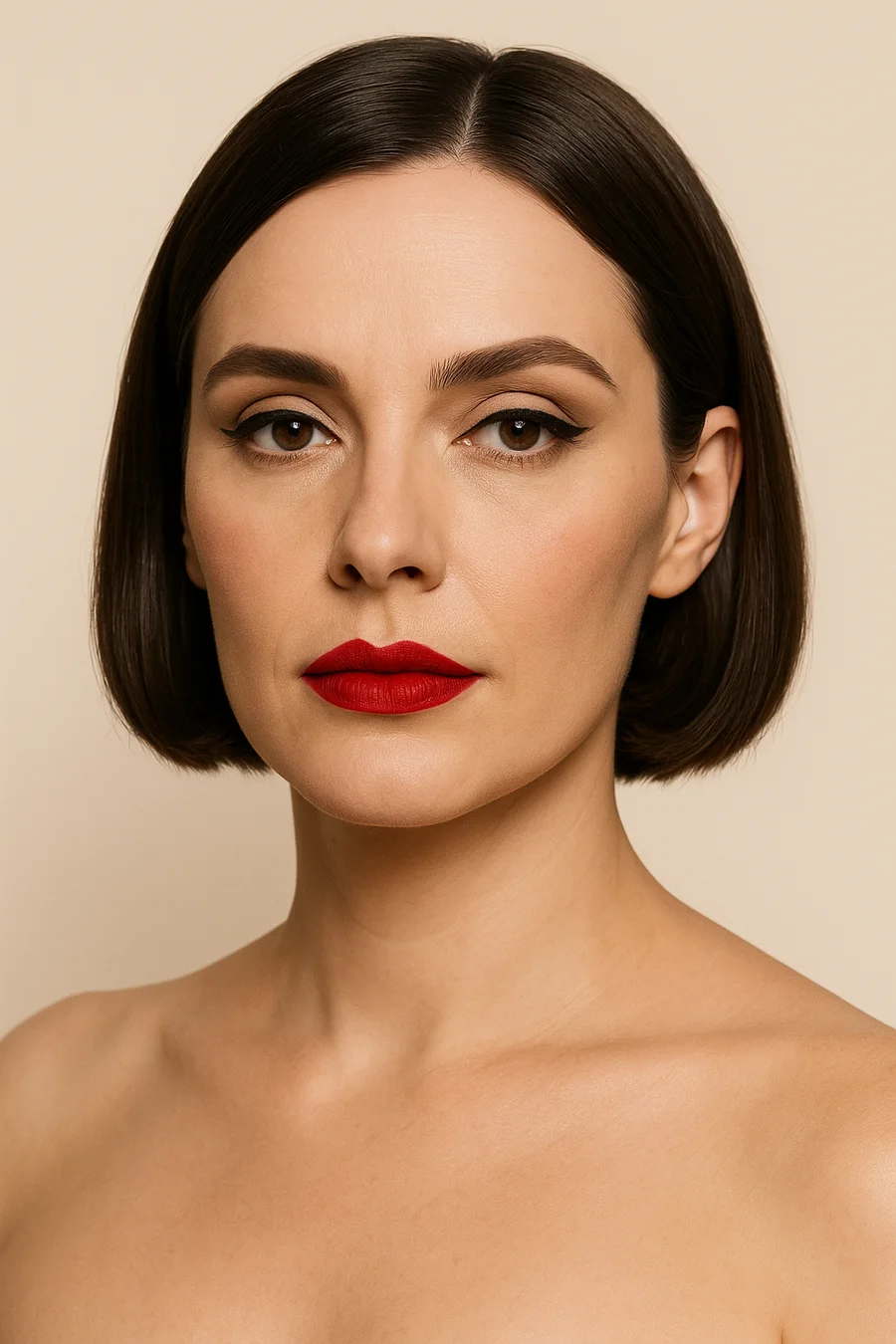
Your makeup concept trades the Classic’s even blend for something with a bit more shape to it — moderately deep, smoky color built up to bring out your bone structure’s slightly angular edge. The effect should look sculpted rather than flat: cheekbones and eyes carved out by color, not just tinted.
That extra shape mirrors the slight Dramatic undercurrent running through the rest of your look. You’re still fundamentally a Classic — controlled, elegant, composed — but the makeup is where a bit of that charisma gets to show through in a defined, deliberate way, rather than staying purely soft and blended.
How to apply the idea
Eyes take a smoky treatment with a noticeably deeper color at the outer lid to carve out a strong shape, kept matte throughout, finished with a deep, slightly smudged liner for real definition. Blush follows the same sculptural logic — place it along the cheekbone in a defined, angular stroke rather than a soft round blend, using a moderately deep color that reads as contour as much as color. Lips stay clean and crisp in outline, with a moderately deep shade that holds its own against the eye and cheek rather than fading into the background — balance across all three is the goal, not any one feature stealing the whole face.
Your colors
Palettes split into four groups by undertone and contrast, Groups I and II running cool and Groups III and IV running warm. Match your own coloring to the nearest group and use the eyeshadow trio — outer lid, orbital bone, highlighter — with the blush and lip shade that lines up below. The structure repeats across every group: a deep lid color to build the smoky base, an orbital shade to shape the crease, and a highlighter to keep the whole eye from reading muddy.
| Group I — Contrast / Winter | |||
|---|---|---|---|
| Eyeshadow (lid / orbital / highlighter) | Blush | Lips | |
| 1 | Navy / Burgundy / Pale Lavender | Cranberry | Cranberry to Soft Burgundy |
| 2 | Royal Purple / Violet / Light Pink | Deep Scarlet | Scarlet |
| 3 | Black / Cobalt / Medium Pink | Soft Fuchsia | Fuchsia (may be frosted) |
| Group II — Dusty / Summer | |||
|---|---|---|---|
| Eyeshadow (lid / orbital / highlighter) | Blush | Lips | |
| 1 | Smoky Purple / Pink / Lavender | Deep Rose | Deep Rose |
| 2 | Dusty Navy / Periwinkle / Medium Pink | Deep Rosy Red | Rosy Red |
| 3 | Soft Charcoal / Mauve / Iced Pink | Soft Fuchsia | Soft Fuchsia (frosted) |
| Group III — Rich / Autumn | |||
|---|---|---|---|
| Eyeshadow (lid / orbital / highlighter) | Blush | Lips | |
| 1 | Sable / Burnished Copper / Mustard | Bronze | Mahogany to Deep Copper (may be frosted) |
| 2 | Forest / Muted Olive / Yellow | Brick Red | Tomato Red |
| 3 | Deep Teal / Smoky Turquoise / Apricot | Terra Cotta | Terra Cotta |
| Group IV — Vibrant / Spring | |||
|---|---|---|---|
| Eyeshadow (lid / orbital / highlighter) | Blush | Lips | |
| 1 | Soft Olive / Khaki / Yellow | Deep Peach | Deep Peach to Melon |
| 2 | Teal / Turquoise / Pale Peach | Orange Red | Clear Red |
| 3 | Soft Chestnut / Honey / Apricot | Salmon Pink | Salmon Pink to Soft Coral Pink (frosted) |
Eyeliner should run several shades deeper than the lid color and stay matte, keeping the whole eye smoky rather than shiny. Lips take matte color as the base, with only a light gloss layered on top where a shade calls for frost — the depth of color is what should read from across the room, not the shine.
Avoid
The two failure points sit at opposite ends of the same problem: too much sparkle, and too little depth. A face piled with glitz or scattered bright color drowns out the sculpted shape you’re building, while an all-neutral, no-smoky face — or a soft pastel one — flattens it out entirely.
- An overly colorful or heavily sparkly, glitzy face.
- A soft pastel or all-neutral face with no smoky depth.
- Watercolor-soft edges, or pale, washed-out lips.
- A bare “no makeup” look.
Want the full picture? Take the quiz to confirm your type, or head back to the Dramatic Classic hub.
Unofficial guide inspired by the Image Identity system in David Kibbe’s Metamorphosis (1987). Body types describe line, not worth — every type is the goal, not a consolation prize.