Romantic Wardrobe Guide: What to Wear
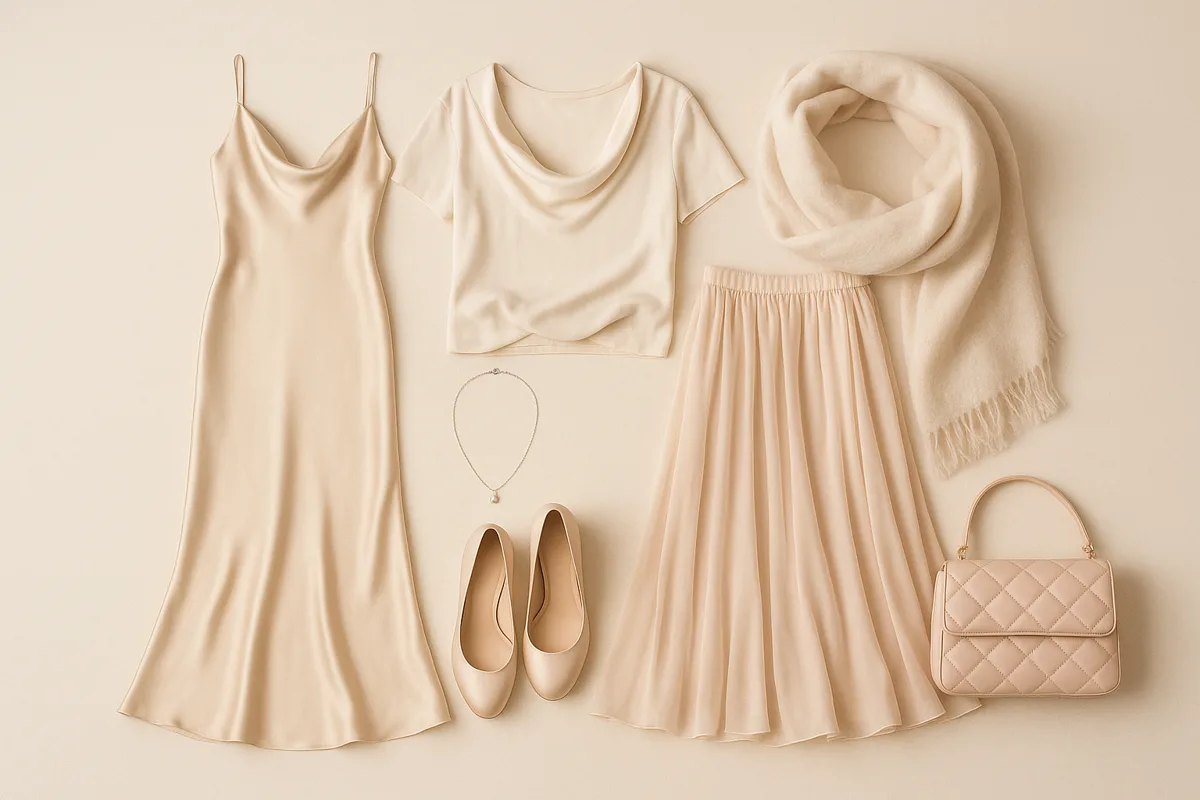
Romantic family · Wardrobe
Every piece you choose is either rounding out your curves or fighting them flat. The Romantic wardrobe has one real job: keep every line soft, curved, and waist-defined, so the lush, hourglass figure you were built with reads clearly instead of getting squared off by tailoring that was never meant for you.
Silhouette & line
Think in circles and soft swirls, never straight edges. Your best silhouette flows and drapes while still showing your waist — the one non-negotiable across every single piece you own. Ornate, intricate shapes work in your favor; a soft bouffant here and there is even welcome, as long as the waistline stays visible underneath.
- Soft, rounded, flowing shapes that always define the waist.
- Gentle draping throughout, from shoulder to hem.
- Circles, curved edges, and ornate swirling lines.
- Severe, tailored, or straight-lined silhouettes.
- Vertical lines that hide or cut through your waist.
- Anything unconstructed, boxy, or horizontal.
Fabrics
Reach for cloth that moves and catches light — nothing stiff, nothing flat. Lightweight, fluid fabrics like challis, crepe, jersey, and tropical-weight wool drape the way your figure wants to be shown. Shine and shimmer belong here too: charmeuse, shantung, crepe de chine, and metallics all read as glamorous rather than gaudy on you, and plush textures — suede, velvet, bouclé, angora — add richness without adding stiffness. Sheers like chiffon, voile, and batiste layer beautifully over the curves underneath.
- Lightweight, draping fabrics: challis, crepe, jersey, tropical wool.
- Ultrashiny fabrics: charmeuse, shantung, crepe de chine, metallics.
- Plush textures — suede, velvet, bouclé, angora — and sheers like chiffon and voile.
- Stiff or heavyweight fabrics that won’t drape.
- Rough textures that fight your softness.
- Extreme matte finishes with no shine or shimmer.
Details
Trim should be soft, intricate, and unmistakably feminine, with a lot of attention paid to framing your face. Oversize bows, flouncy ruffles, and delicate lace all read as luscious rather than juvenile at your scale. Necklines curve and drape; shoulders round out with soft pads, gathers, or a leg-o’-mutton sleeve; sleeves taper at the wrist with intricate buttons or fall soft and flowing. Sparkle — pearls, sequins, beading — is a genuine asset here, not an accent to ration. And the waist gets emphasized everywhere: soft gathers, folds, a draped sash, a supple cinching belt with an ornate buckle.
- Oversize bows, flouncy ruffles, delicate lace at every scale.
- Curved, draped necklines and rounded shoulder details.
- Waist emphasis via gathers, sashes, or an intricate cinching belt.
- All tailored, angular, or severe detailing.
- Chunky, rough, or oversized trim.
Jackets & tops
A jacket only works for you fitted at the waist — a peplum, a nipped seam, or a soft belt all do the job. Curved, rounded, or shawl lapels suit you far better than a notched collar, and rounded shoulder pads with gathers or a bit of bouffant shape finish the silhouette properly. Blouses stay soft and draped with a bit of sophisticated flounce; sweaters do best fluffy, clingy, or plush, kept short with some waist detail and a cowl neck rather than anything crew-necked.
- Jackets fitted at the waist with peplums, nipped seams, or soft belts.
- Curved, rounded, or shawl lapels; rounded shoulder pads with gathers.
- Soft, fluffy, or plush sweaters, short and waist-detailed, with a cowl neck.
- Tailored jackets — blazers, double-breasted, boxy shapes.
- Long straight jackets that hide the waist, or shapeless, unconstructed cuts.
- Skinny ribbed knits, thick nubby knits, turtlenecks, or crew-necked shetlands.
Skirts & pants
Skirts should be full and flowing, gathered softly at the waist, with an uneven hemline if you like. What passes for your “straight” skirt is really tulip-shaped — full at the waist, tapered at the hem, kept short. Flared styles of every kind work well: trumpets, swing shapes, bias cuts, gores. Keep lengths either gracefully long, around mid-calf, or short with an even hem at the kneecap. Pants should be just as soft and draped, gathered at the waist and tapered or pegged at the ankle.
- Full, flowing, gathered skirts — trumpets, swing shapes, bias cuts.
- Tulip-shaped “straight” skirts, full at the waist and tapered at the hem.
- Soft, draped pants gathered at the waist, tapered or pegged at the ankle.
- A-line and pleated skirts; straight or tailored skirts.
- Straight or tailored pants with sharp pleats, cuffs, or pockets.
- Baggy, unconstructed pant shapes.
Dresses
A dress should feel feminine and flowing from the moment you put it on, with waist emphasis and ornate detail carrying the whole look. Swirling or flouncy skirts finish it off — the kind of dress that moves when you do.
- Feminine, flowing dresses with clear waist emphasis.
- Ornate detail and swirling or flouncy skirts.
- Stiff, structured, or tailored styles like a coatdress or chemise.
- Straight, no-waist styles, or shapeless, baggy dresses.
Color & prints
Color is where your femininity really gets to speak — reach for a soft, watery blend of pastel and vivid rather than anything flat or single-toned. Group your palette by mood rather than by name: warm, sun-washed hues like salmon and melon carry a lighter, playful feeling; deeper, romantic tones like raspberry and grape read moodier; and rose sits comfortably between the two. Whatever the mood, let neutrals do supporting work only — a soft taupe, a warm bone, an easy white, or a cool dove gray — never the star of the outfit. Prints should feel hand-painted rather than plotted: loose abstract color washes, and blooms rendered large and soft-edged rather than crisp.
- A soft, watery mix of pastel and vivid color, grouped by mood — sunny (salmon, melon), moody (raspberry, grape), and rose in between.
- Neutrals — taupe, bone, white, dove gray — kept to a supporting role, never the main event.
- Hand-painted, large-scale abstract washes and soft-edged floral blooms.
- Dark or neutral monochromatic color schemes.
- Sharp color contrast.
- Geometric, symmetrical, or small prints, plus stripes and plaids.
Accessories & jewelry
Every accessory should read as feminine, ornate, and softly sophisticated — lavish in effect, but delicate and intricate in the actual workmanship. Shoes stay delicate and strappy with a slender heel and a tapered or open toe. Bags should be small and rounded, in soft supple leather or fabric, with beading, gathers, or trim doing the ornamentation. Belts want soft leather, an intricate buckle, and a cinched-waist effect — treat the belt as a piece of jewelry in its own right. Hats should curve rather than crisp up, and jewelry is where you can go furthest: delicate but lavish, rounded, dangling, sparkly, with an antique or baroque effect.
- Delicate, strappy shoes with a slender heel and tapered or open toe.
- Small, rounded bags in soft leather or fabric with ornamentation.
- Sparkly, rounded, dangling jewelry with an antique or baroque effect.
- Tailored, chunky, or angular shoes and bags.
- Stiff belts, geometric buckles, and plain unadorned pieces.
- Heavy chunky jewelry, sharp edges, or minimal, geometric styles.
Evening
Evening is where you can layer it on. Fitted shapes with ornate necklines and waist emphasis are the foundation; sheer, plush, and sparkly fabrics all belong, along with elaborate trim. An hourglass ball gown, a swirling chiffon gown, an ornate or draped cocktail dress, or a bustier dress all read as exactly, gloriously you.
- Fitted evening shapes with ornate necklines and waist emphasis.
- Sheer, plush, or sparkly fabrics with elaborate trim.
- Hourglass ball gowns, swirling chiffon gowns, or bustier dresses.
Want the full picture? Take the quiz to confirm your type, or head back to the Romantic hub.
Unofficial guide inspired by the Image Identity system in David Kibbe’s Metamorphosis (1987). Body types describe line, not worth — every type is the goal, not a consolation prize.