Romantic Makeup Guide
Romantic family · Makeup
The Watercolor Face
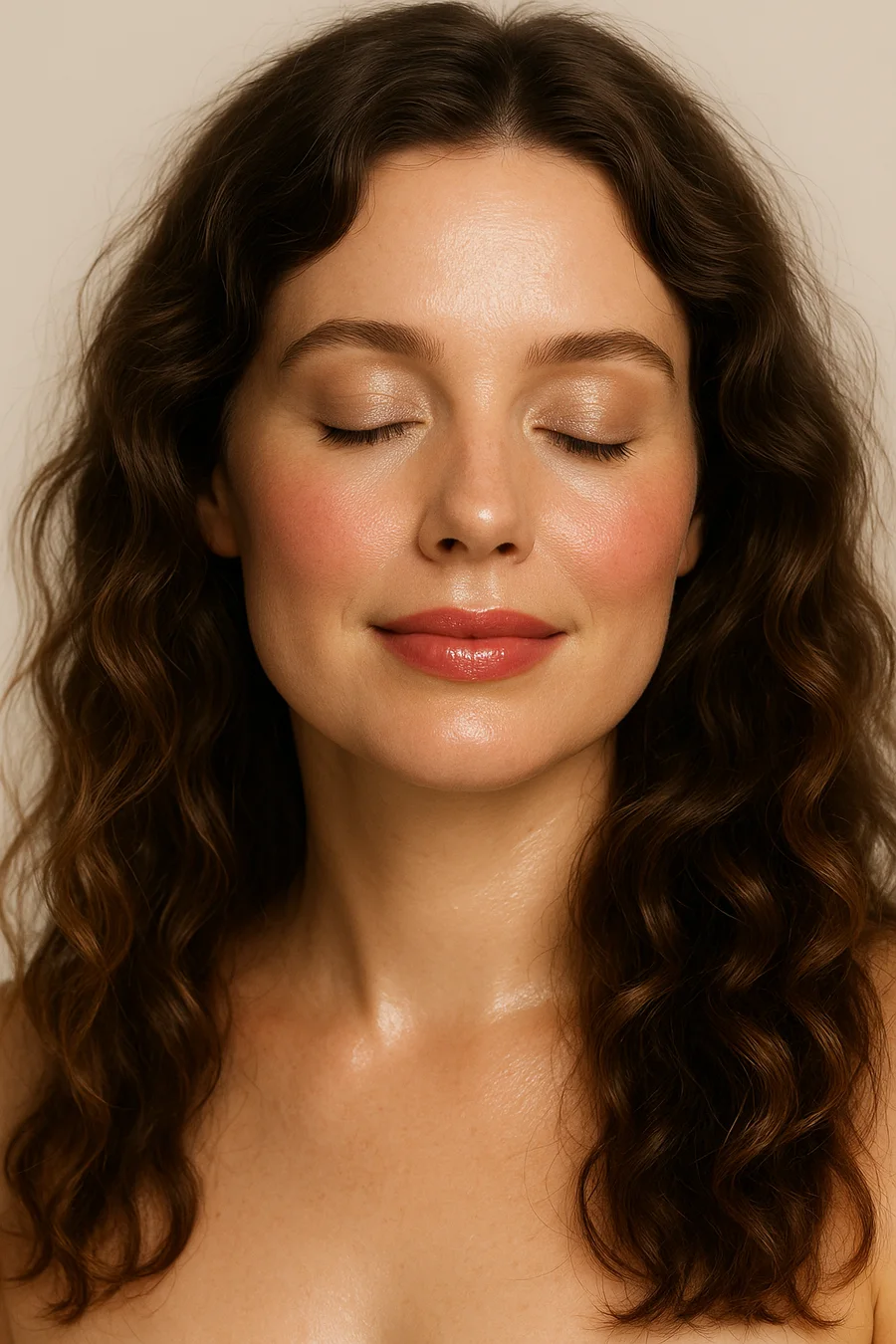
Your makeup concept is exactly what it sounds like: a face built from rounded washes of gentle color, with shimmer worked all through it rather than dabbed on as an afterthought. The goal isn’t precision or contour — it’s a face that looks painted with a soft brush, glowing rather than sculpted.
This is the same logic that runs through your hair and your clothes — round, soft, richly colored, never sharp or flat. Kibbe frames the whole Romantic look as artistic and lush, a woman who could have stepped out of another era entirely, and the face carries that idea more literally than any other part of the wardrobe. Skip the color or the sparkle and the effect reads tired rather than restrained.
Daytime and evening both stay firmly in “color,” just at different volumes. Soft pretty shades — rose, peach, rust, pink — belong on cheeks and lips even for a Tuesday afternoon, and a bit of sparkle around the eyes is expected rather than optional at any hour. Evening simply turns the same dial higher: more shimmer, more color, more glitz, never a switch to something more neutral or restrained.
How to apply the idea
Start with the eyes, since they’re doing most of the work. Build a deep, smudged color across the lid, then bring in a bright orbital-bone shade and a colorful highlighter — the combination is what creates that painted, swirled effect rather than a single flat wash. Line the eyes in a dark, smudged pencil rather than a crisp precise flick, and don’t be shy with mascara. On the cheeks, keep the blush rounded rather than contoured into an angle, and add a touch of sparkle — a swept-on iridescent powder, or a light dusting of a frosted eyeshadow over the top. Lips should accentuate their natural fullness: bright color, a frosted finish, and a heavy layer of gloss on top. Every element should feel blended into the next rather than separated into distinct zones — that’s the “watercolor” part of the name.
Your colors
Kibbe splits palettes into four color groups by undertone and contrast. Find the group closest to your natural coloring — Group I and II run cool, Group III and IV run warm — and use the eyeshadow trio (outer lid, orbital bone, highlighter) with the matching blush and lip numbers below. The eyeliner should sit in the same tone family as your lid color, just two shades deeper; the outer lid can stay matte if you like, but the orbital bone and highlighter should always carry some iridescence. Heavily frosted shadow is worth saving for evening, though even your daytime eye makeup should read as a soft, shimmering swirl rather than a flat coat of color.
| Group I — Contrast / Winter | |||
|---|---|---|---|
| Eyeshadow (lid / orbital / highlighter) | Blush | Lips | |
| 1 | Navy / Frosted Violet / Sparkly Lilac | Magenta | Magenta |
| 2 | Royal Purple / Magenta / Frosty Lavender | Scarlet | Scarlet |
| 3 | Charcoal / Shimmering Cobalt / Sparkly Pink | Hot Pink | Hot Pink |
| Group II — Dusty / Summer | |||
|---|---|---|---|
| Eyeshadow (lid / orbital / highlighter) | Blush | Lips | |
| 1 | Smoky Purple / Fuchsia / Sparkly Lilac | Bright Pink | Light Pink |
| 2 | Soft Navy / Frosty Periwinkle / Sparkly Pink | Rosy Red | Bright Rosy Red |
| 3 | Blue-Gray / Frosty Pink / Sparkly Lavender | Orchid | Orchid |
| Group III — Rich / Autumn | |||
|---|---|---|---|
| Eyeshadow (lid / orbital / highlighter) | Blush | Lips | |
| 1 | Teal / Frosty Turquoise / Sparkly Peach | Bright Rust | Bright Russet |
| 2 | Olive / Frosty Khaki / Sparkly Apricot | Bright Tomato | Bright Tomato |
| 3 | Chestnut / Frosty Copper / Sparkly Gold | Bright Peach | Light Copper |
| Group IV — Vibrant / Spring | |||
|---|---|---|---|
| Eyeshadow (lid / orbital / highlighter) | Blush | Lips | |
| 1 | Teal / Frosty Aqua / Shimmering Peach | Bright Coral Pink | Bright Coral Pink |
| 2 | Jade / Bright Green / Shimmering Apricot | Poppy Red | Clear Red |
| 3 | Honey-Brown / Frosty Copper / Shimmering Yellow | Bright Apricot | Bright Melon |
Lipstick should always be frosted, and pale shades can carry noticeably more frost than deep ones — finish every lip with a heavy layer of gloss on top, no exceptions. The same shimmer rule carries through blush: a slight sparkle keeps cheeks from reading flat against all that color elsewhere on the face.
Avoid
The failure mode here is the opposite of most types: too little color and too little shine, not too much. A bare, neutral face reads as tired rather than restrained on you, and matte, smoky products flatten the softness that’s the whole point of the concept. Even a well-blended face can go wrong if it forgets the sparkle entirely — the shimmer isn’t decoration here, it’s part of what makes the color read as soft rather than flat.
- A neutral, “no-color” face lacking sparkle.
- High-contrast color or angular cheek contouring.
- All-matte products with no frost or shimmer anywhere.
Want the full picture? Take the quiz to confirm your type, or head back to the Romantic hub.
Unofficial guide inspired by the Image Identity system in David Kibbe’s Metamorphosis (1987). Body types describe line, not worth — every type is the goal, not a consolation prize.