Gamine Wardrobe Guide: What to Wear
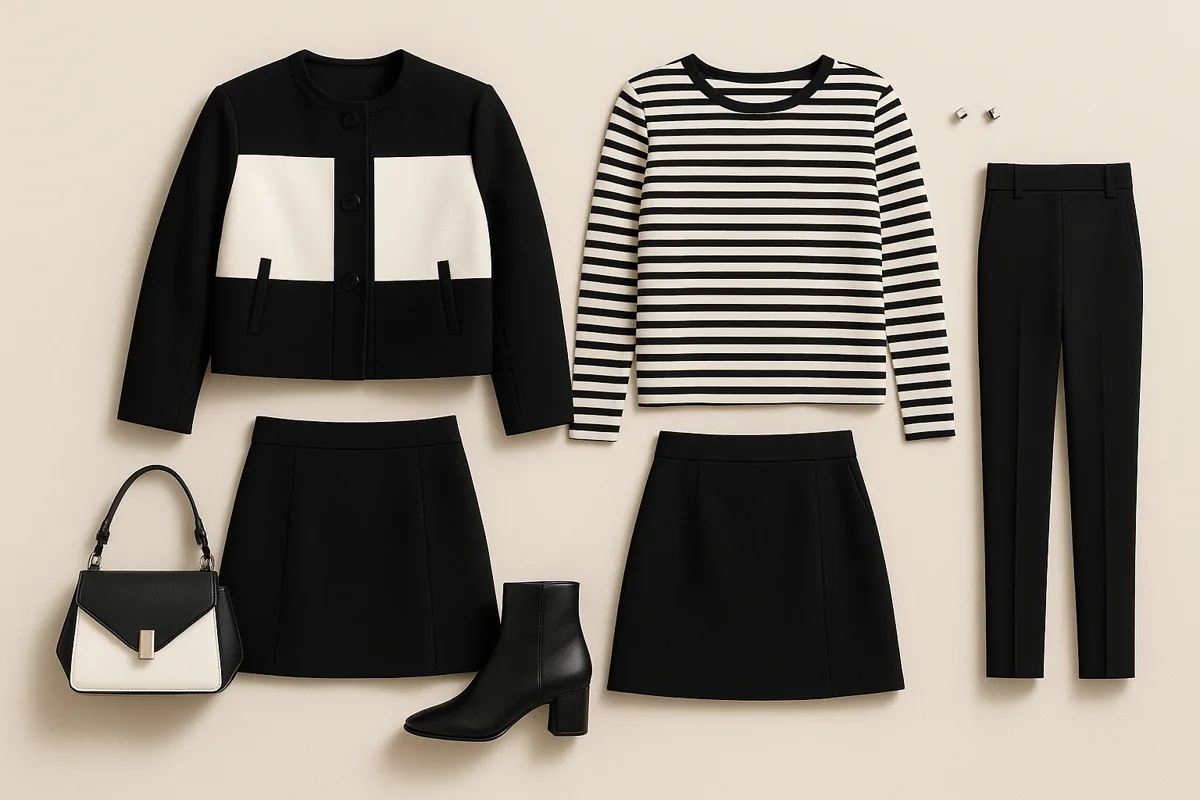
Gamine family · Wardrobe
Nothing on a Gamine works if it’s plain. Your whole wardrobe runs on a paradox — tiny scale, sharp edges, and an almost reckless amount of detail, all at once — so the goal on every single piece is to keep it small, keep it crisp, and never let it go quiet.
Silhouette & line
Stay tiny and geometric. Your best shapes are small and pointed rather than sweeping, fitted with real precision instead of left loose, and your outline should look broken up — short, choppy segments rather than one long unbroken sweep. A run of short horizontal lines across a garment reads as pure you. Piling on detail only reinforces that tightly fitted, busy silhouette — it’s not excess, it’s the point.
- Small, pointed geometric shapes, fitted with precision.
- A broken, choppy outline built from short segments rather than one sweep.
- Short horizontal lines and generous detail to reinforce the fit.
- Long, flowing, curved, or wide lines.
- Shapes and silhouettes that read big or lack real construction.
- Symmetrical or overly ornate silhouettes.
Fabrics
Crispness is non-negotiable — you need cloth that can hold a shape and take a sharp press, not fabric that goes soft the moment you move. Flat weaves and a fine, tightly ribbed knit are reliable choices. Matte is the default finish, though a hard, gleaming surface — metallic especially — can be a genuine thrill on you. Weight should sit in the moderate range, though anything lighter that still hugs the body works just as well.
- Crisp, shape-holding fabric — flat weaves or lightly textured cloth.
- Fine, tightly ribbed knits.
- Matte finishes, with hard metallic sheen as an exciting exception.
- Oversized, rough-textured cloth.
- Sheer or flowing fabric.
- Delicate fabric that can’t hold its shape.
Details
There’s really no such thing as overdoing it here — piling on small, crisp detail is one of the sharpest tools you have for reading as animated rather than flat. Outline everything: collars, cuffs, waistbands, and lapels, all trimmed in contrasting piping, braid, or beads. Necklines should stay small and pointed — Mandarin, Nehru, a tight little V, a wing tip — with tiny crisp pleats, narrow ties, small cuffs, and a sharply, narrowly defined waist throughout.
- An abundance of small, crisp, contrasting detail everywhere.
- Outlined collars, cuffs, waistbands, and lapels — piping, braid, beads.
- Small pointed necklines: Mandarin, Nehru, tight V, wing tip.
- Minimal or overly simple detail.
- Oversized or unconstructed trim.
- Ornate, frilly, or elongated detail.
Jackets & tops
Keep jackets short, cropped, and fitted within an inch of its life — sharp edges, real construction, nothing loose. A cropped blouson shape is a standout choice, and every edge should carry its own trim. Blouses want the same tailored crispness: sharp seams, crisp details, stiff cotton or smooth silk. Sweaters do best skinny and ribbed, or in a cropped “poor-boy” shape — thicker knits only earn their place pulled in tight at the waist.
- Short, cropped, sharply fitted jackets — blouson shapes excellent.
- Tailored blouses in stiff cotton or smooth silk, crisp seams and cuffs.
- Skinny ribbed sweaters or cropped poor-boy styles.
- Long or unconstructed jackets, or anything flouncy.
- Frilly or flimsy blouses.
- Oversized, heavy-textured, or fluffy sweaters.
Skirts & pants
Keep the skirt line narrow, crisp, and short, snug through the waistband and tapering as it falls. A touch of flare is fine, but only if the hip and thigh stay clean — pin any fullness down into a fitted pleat rather than letting it swing loose. Hemlines belong anywhere from mini to just above the knee, with a slightly longer allowance to the top of the calf if there’s a bit of flare; go past that and you’ll need a slit and a pencil-narrow cut to pull it off. Pants follow the same logic — precise tailoring, detail worked into the waistband, pleat, and cuff, hem cropped anywhere from mid-calf to the ankle bone. Stretch fabric worn skin-tight is a near-guaranteed win.
- Narrow, crisp, tapered skirts, hemline from mini to just above the knee.
- Precisely tailored, cropped pants with detail worked into waistband and cuff.
- Skin-tight stretch fabric.
- Skirts that are full, flouncy, oversized, or lack construction.
- A-line or symmetrical skirt shapes, or hemlines that run long.
- Baggy, plain-front pants, or anything draped with a leg that tapers in.
Dresses
Your dress should be slim, tailored, and edged with sharpness, layered with small crisp detail rather than left plain. A dropped waist or a chemise shape works well as long as it stays narrow, and a short cropped jacket, vest, or bolero over the top is an easy add. Come nightfall, an asymmetrical hemline is genuinely fun on you — something echoing a 1920s flapper tends to land beautifully. A narrow, clingy knit dress is also a strong option.
- Slim, tailored dresses, edges sharp, layered with small crisp detail.
- Narrow dropped-waist or chemise shapes, cropped jackets or boleros layered on top.
- Asymmetrical hemlines for evening, with a 1920s flapper feel.
- Flouncy dresses, or ornate shirring and draping.
- Plain dresses with no detail at all.
- Shapes that read wide or lack real construction.
Color & prints
Rules are for other people — go bold, go sassy, and don’t be afraid of piling on several colors at once. A shockingly bright accessory set on top of a plain backdrop, light or dark, lets the contrast carry the whole outfit; wild pairings that clash on paper somehow work on you. Prints want that same energy: sharp, colorful, animated. Tiny geometric or angular shapes with an asymmetric twist read well, and a print with a modern, almost Picasso-esque edge — or even a touch of cartoon humor — can be a genuine win. Give a print an outline and it punches even harder.
- Bold, sassy color — many shades at once and combinations that clash on purpose.
- A shockingly bright accessory set against a plain, light or dark backdrop.
- Tiny geometric or angular asymmetric prints, modern or playful in spirit.
- Monochromatic color schemes — the single biggest miss for this line.
- Neutrals worn as more than an accessory, unless taken to a near-black or near-white extreme.
- Watercolor, ornate, intricate, symmetrical, oversized, or realistic prints.
Accessories & jewelry
Every accessory is a chance to add more staccato punctuation, so nothing here should be plain, oversized, or dull-colored. Shoes read best cut trim and angular, built from a light leather — an offbeat toe or heel shape, a saturated color, or a printed surface all earn their place, and any kind of flat works too. Bags stay small and geometric, think boxes, clutches, and slim cases; belts run stiff with a geometric buckle, or elasticized in a bright shade; hats stay small and neatly built, along the lines of a beret or a cloche. Break up hosiery by mismatching stocking, hemline, and shoe tone on purpose, and keep jewelry small, sharp, geometric, and brightly enameled, with a slightly avant-garde edge.
- Trim, angular shoes cut from light leather; any style of flat.
- Small geometric bags and belts, stiff-buckled or elasticized and bright.
- Small sharp jewelry, colored enamel or glass; deliberately mismatched hosiery.
- Plain pumps, or overly delicate and strappy shoes.
- Oversized, unconstructed, or heavy bags.
- Heavy or unconstructed belts.
- Antique, ornate, heavy, or symmetrical jewelry.
Evening
Evening is where the sleekness turns up: slinky, geometric shapes cut from a smooth surface, edges crisply tailored, dressed up with beading and a hard metallic gleam. Necklines run angular, finished with crisp, colorful trim at the collar and cuff, and an asymmetrical hem is always fair game. A very bare slinky sheath, a short beaded jacket layered over a gown, a close, dropped-waist dress, or a tailored dinner suit with a cropped jacket all read as pure Gamine — and a tailored evening pantsuit holds its own just as well.
- Slinky, bare sheaths and close dropped-waist dresses.
- Short beaded jackets, tailored dinner suits, and evening pantsuits.
- Hard metallics, beading, and crisp colorful trim at collar and cuff.
Want the full picture? Take the quiz to confirm your type, or head back to the Gamine hub.
Unofficial guide inspired by the Image Identity system in David Kibbe’s Metamorphosis (1987). Body types describe line, not worth — every type is the goal, not a consolation prize.