Dramatic Hair & Color Guide
Dramatic family · Hair & Color
Your cut
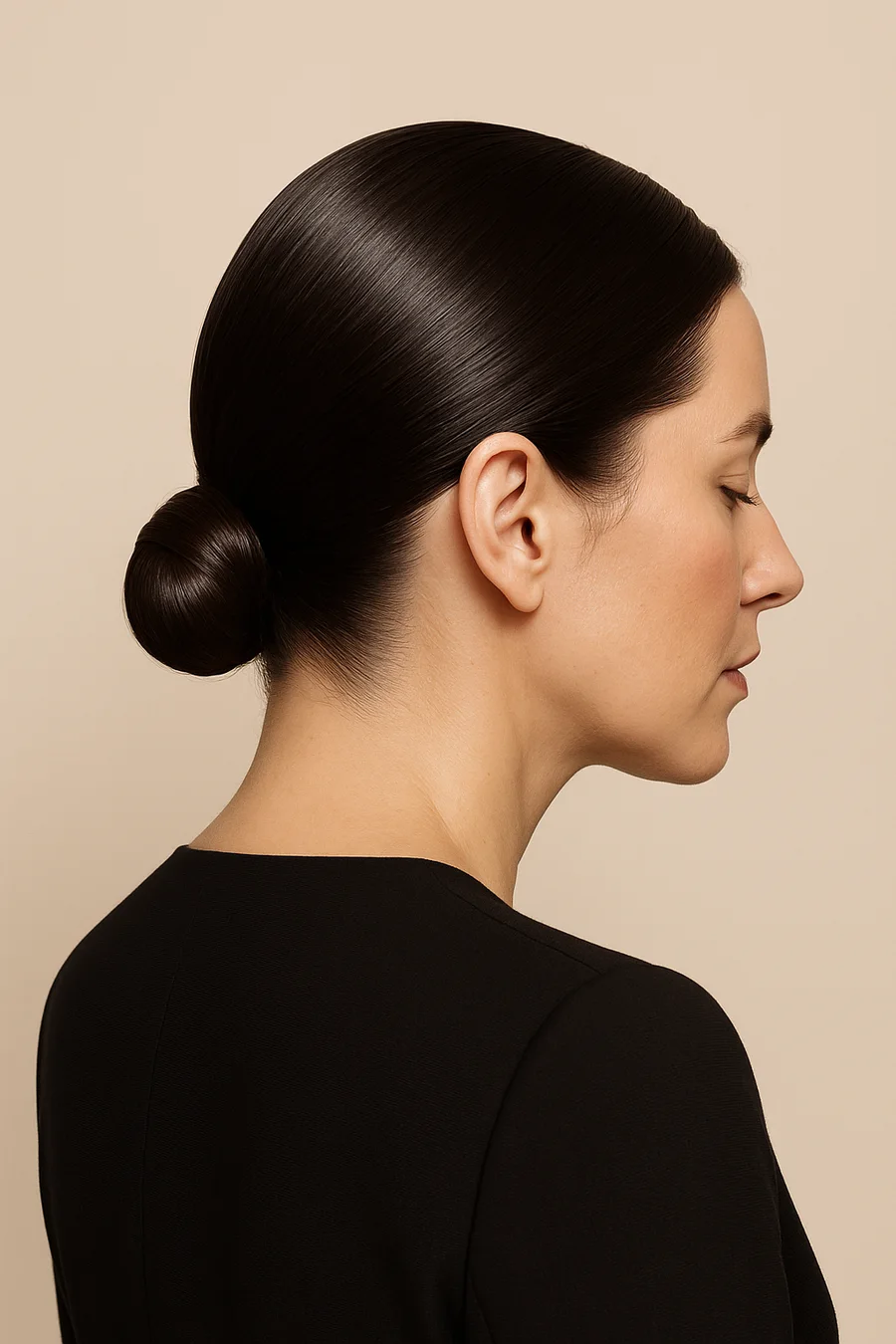
Sleek and sculpted is the whole assignment. Your hair should look geometric in shape and usually swept back off the face, so the bone structure that makes you a Dramatic in the first place gets to lead. That’s true whether your hair is fine and straight or thick and curly — the texture can vary, but the shape stays architectural. Think of your hair as another surface for the same sharp geometry that runs through your clothes: a strong line at the part, a clean edge at the jaw or shoulder, nothing left loose to soften the silhouette.
Whatever your natural texture, the goal is the same: reveal the cheekbones and jaw rather than curtain them. Fine, straight hair can be cut into a severe, graphic shape with minimal effort; coarse or curly hair can be shaped into something equally architectural, worn back or up rather than left to fall forward. Either way, the hair should look like it was designed, not just grown out. Of the three places Kibbe points to as the fastest way to see this essence in action — geometric hair, high-contrast makeup, a sharply cut silhouette — hair is arguably the quickest win, since one strong cut can announce the whole look before the rest of the outfit even arrives.
- Overly soft, coiffed, or wispy styles — few choices date this look more brutally.
- Soft hair that hangs in or covers the face, hiding the very structure it should reveal.
Your haircolor
Vivid and distinct is the concept, whatever hue you land on. Softening or muting your natural intensity works against you here more than almost anywhere else in the wardrobe — an all-over color process reads best, since highlighting tends to wash the look out. Use your skin’s undertone and your natural contrast level to pick a lane. Undertone follows the same warm-or-cool logic that guides the rest of your color choices; contrast is a matter of how much your natural hair color differs from your skin tone — a wide gap reads high-contrast, a closer gap reads low-contrast — and the chart below sorts the recommended shades along both of those lines.
| Warm skin (golden) | Cool skin (blue) | |
|---|---|---|
| High-Contrast | Deep to Medium Chestnut Brown; Mahogany or Deep Auburn; Warm White; cover gray completely | Black; Dark Ash Brown; Silver or White; gray may stay if dramatically streaked |
| Low-Contrast | Medium to Light Golden Brown; Light to Bright Auburn through Copper; Deep Honey Blond; Warm White; cover gray completely | Medium to Soft Ash Brown; Deep to Light Ash Blond; bold streaks of Ash Blond; cover gray completely |
An overall color process is almost always the right call — highlighting only earns its place when it’s one dramatic streak or sweep, not a full head of subtle lightening. Even gray can stay in the picture rather than get covered, as long as it’s worked in as a deliberate, dramatic streak instead of scattered evenly through the whole head. The through-line across every option in the chart is the same: pick a lane, and commit to it fully rather than blending toward the middle.
- Any haircolor chosen to “soften” your natural look — it works against the majesty this type is built on and ages the face faster than almost anything else.
It’s a common instinct to reach for a softer shade as a way of easing into a bolder look, but for this type the instinct backfires — the softened version consistently reads as older and less finished, not gentler.
Your palette
Dress in complete color statements rather than piecing separates together. Deep, complementary shades and dark neutrals are your natural allies, and a bold-but-elegant pairing — something bright set against something dark — reads as confident rather than loud. A full pastel outfit, worn head to toe, can be just as striking. Monochromatic dressing, one color from top to bottom, is one of the strongest moves available to you. When you do reach for pattern, keep it bold and geometric — stripes, zigzags, asymmetric shapes, high-contrast combinations with a contemporary feel — rather than anything soft-edged or painterly.
- Head-to-toe color schemes in deep, complementary shades.
- Dark neutrals and bold-but-elegant bright-against-dark pairings.
- Full monochromatic outfits, including all-pastel ensembles.
- Multicolor splashes or mix-and-match combinations that break up your line.
Taken together, your cut, your haircolor, and your clothing color are all doing the same job: keeping every choice bold, distinct, and readable from across the room, rather than blended into something safer. Treat that as the single test behind every decision on this page, and the rest tends to follow naturally.
Want the full picture? Take the quiz to confirm your type, or head back to the Dramatic hub.
Unofficial guide inspired by the Image Identity system in David Kibbe’s Metamorphosis (1987). Body types describe line, not worth — every type is the goal, not a consolation prize.