What Dramatics Should Never Wear (and What to Wear Instead)
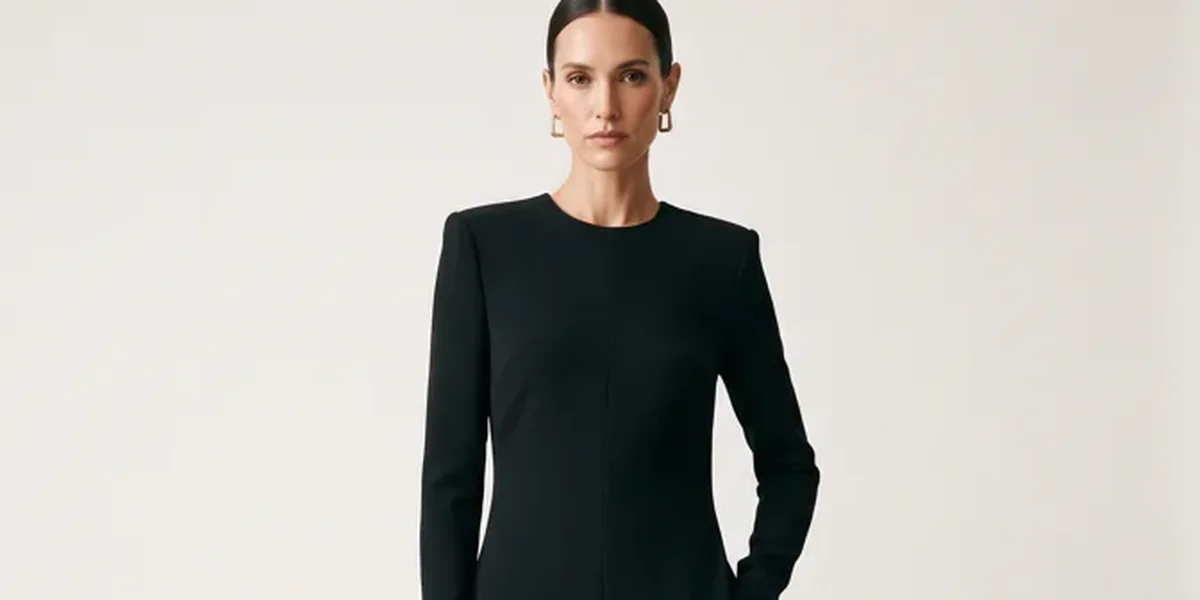
Dramatic family · What to avoid
The Dramatic line is built on extremes — sharp, long, and geometric — so anything that rounds it off, breaks it up, or dresses it up with fuss undoes the whole effect. The avoids below aren’t arbitrary rules; each one is something that quietly cancels the sculptural line the rest of your wardrobe is working to build. Kibbe’s balance doctrine is simple in principle: your natural line already sits at the sharp, extreme-Yang end of the scale, so anything you add should sharpen that statement further, not blur it back toward the middle. A single soft, fussy, or shapeless piece can undo an otherwise commanding outfit, which is exactly why the list below is worth knowing by heart. Read each theme as a quick gut check before you get dressed, not a set of restrictions to memorize word for word.
Soft, rounded, or draped shapes
Rounded or swirled shapes, soft flowing lines, drapey pants, and flouncy dresses all soften an outline that’s meant to stay sharp.
- Rounded, swirled, or overly draped shapes.
- Soft, flowing lines and drapey or clingy tapered pants.
- Flouncy or flowing dress styles.
- Sharp, geometric shapes — triangles, rectangles, elongated sculptural lines.
- Straight, man-tailored pants with a long hem.
- Elongated, sleek, tailored dresses with sharp shoulders.
Fussy and ornate detail
Anything delicately intricate reads as fussy on your scale, not pretty — ruffles, lace, feathers, bows, and small symmetrical trim all fight the clean geometry that’s your real strength. The scale mismatch is the real issue: your features and frame are built in bold strokes, so intricate, small-scale ornamentation just gets lost, or worse, looks like it landed on the wrong person.
- Delicately intricate or fragile detail; small fussy trim.
- Ruffles, lace, feathers, bows, tucks, and gathers.
- Watercolor prints, florals, soft swirls, or small symmetrical prints.
- Delicate antique jewelry and small symmetrical pieces.
- Clean, minimal detail and bold sweeping geometrics.
- Bold geometric prints — stripes, zigzags, asymmetrics, irregular shapes.
- Sleek, bold, modern jewelry with sharp lines.
Unconstructed or shapeless cuts
A garment with no structure has nowhere to hang on your frame but flat — shapeless jackets, oversized sleeves, and baggy pants erase the shoulder and leg lines you’re built to show off. Structure is what turns your height and length into a statement instead of just extra fabric; take it away and the same long lines start to look like you’re swimming in your clothes rather than commanding them.
- Unconstructed or sloppy silhouettes.
- Shapeless or boxy jackets; oversized, shapeless sleeves.
- Oversized or baggy pant shapes.
- Tailored jackets with defined, square shoulders.
- Clean, structured sleeves and cuffs.
- Straight, man-tailored pants.
Sheer, clingy, or overly heavy fabrics
Fabric with no body of its own — or fabric so heavy and rough it overwhelms rather than supports — works against the crisp, sleek surface your line depends on. Think of fabric weight as part of your silhouette, not a separate decision — the wrong weight can undo a perfectly cut garment before it even leaves the hanger.
- Sheer, floating lightweight fabrics.
- Clingy fabrics that soften your edges.
- Extremely rough or overly heavy textures.
- Moderate to heavyweight, matte, smooth, tightly woven fabrics.
- Structured lightweights when you want something lighter.
- Shiny fabrics only when they’re stiff enough to hold their shape.
Broken lines and multicolor mixing
Horizontal breaks and scattered color both interrupt the long vertical statement your line is making — keep the eye moving up and down, in one color story. A hemline that cuts across the leg at the wrong point, or an outfit assembled from too many separate colors, does the same damage as a fussy ruffle: it chops up a line that’s supposed to read as one uninterrupted sweep.
- Broken or horizontal lines.
- Multicolor splashes or mix-and-match dressing.
- Long, unbroken vertical lines.
- Head-to-toe color schemes, including full monochromatic looks.
Soft hair and softened haircolor
A wispy cut or a muted, “softened” haircolor undercuts the same bone structure your clothes are built to reveal — the effect reads as tired rather than gentle. It’s worth calling out on its own because it’s easy to miss: the instinct to soften a strong feature usually comes from a good place, but on a Dramatic it consistently reads as older and less finished, never as more approachable.
- Overly soft, coiffed, or wispy hairstyles; hair that hangs in or covers the face.
- Haircolor chosen to soften or mute your natural intensity.
- Sleek, sculpted, geometric hair swept off the face.
- Vivid, distinct haircolor, processed as an overall color.
Want the full picture? Take the quiz to confirm your type, or head back to the Dramatic hub.
Unofficial guide inspired by the Image Identity system in David Kibbe’s Metamorphosis (1987). Body types describe line, not worth — every type is the goal, not a consolation prize.