Classic Wardrobe Guide: What to Wear
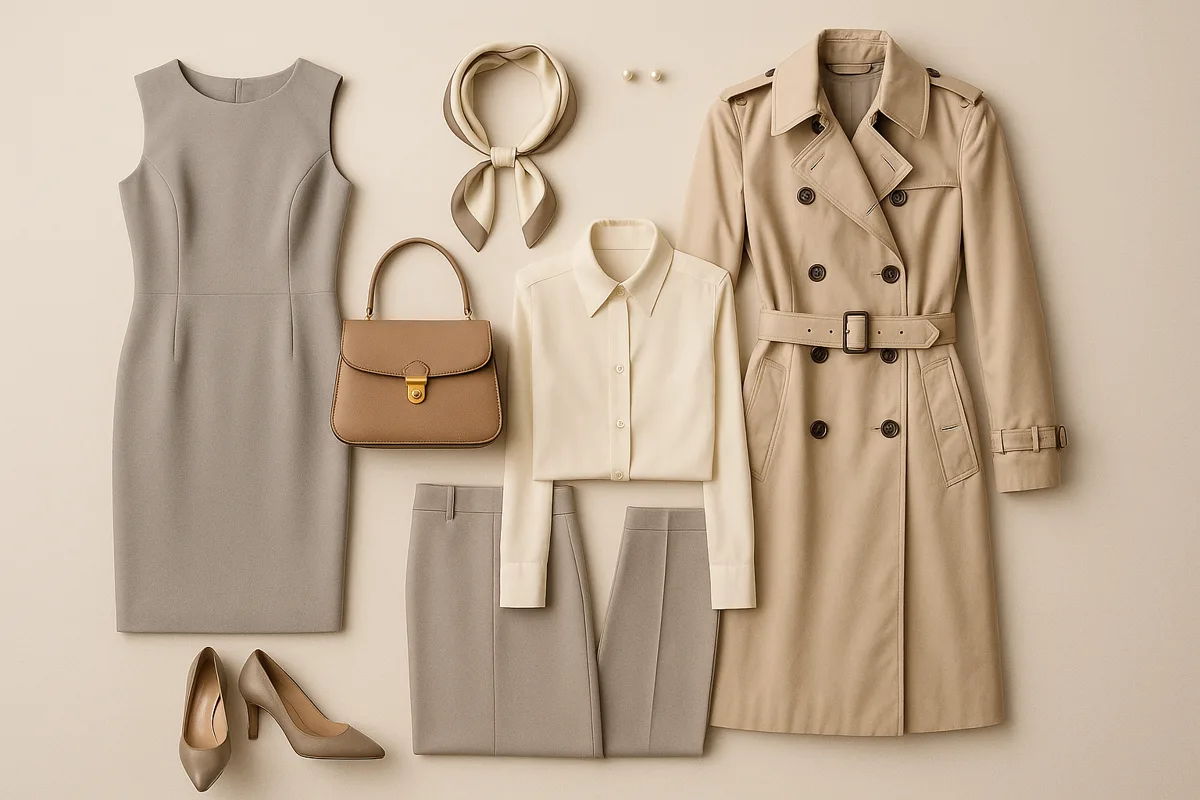
Classic family · Wardrobe
The Classic wardrobe runs on one quiet rule: everything should blend into a single, uninterrupted line. Not boring — balanced. Every piece below is chosen because it holds that even, symmetrical outline instead of pulling it toward sharp edges on one side or soft flounce on the other.
Silhouette & line
Your silhouette wants to read as one continuous shape from shoulder to hem — soft straight lines or gently curved ones, tailored just enough to look intentional without ever looking severe. Whether a piece leans slightly geometric or slightly curved, the rule stays the same: pair matching shapes together rather than mixing an angular piece with a rounded one, so the whole look lands symmetrical no matter which way it bends. The goal is an outline with no jarring edges anywhere along it: nothing flares out unexpectedly, and nothing snaps into a hard angle either.
- A smooth, symmetrical outline with controlled, even edges.
- Soft straight lines or lines that curve gently, never sharply.
- Softly tailored shaping, with a slight flow where it suits the piece.
- Sharply angular or heavily geometric shapes.
- Elaborately ornate or fussy shaping.
- Fully rounded or exaggeratedly curved shapes.
- Loose, unconstructed shapes with no defined edge.
- Overly flouncy or overly sharp silhouettes that break the line.
Fabrics
This is where you’re allowed — encouraged, even — to spend on quality. Beautiful, expensive-looking cloth in moderate weights does more for your line than any cut trick: French silks, Italian gabardine, raw silk, shantung, linen, smooth cashmere or softly ribbed knits. Finish should sit at matte or the faintest sheen, with just enough weight to drape cleanly in a tailored piece rather than clinging or standing stiff.
- French silks, Italian gabardine, raw silk, shantung, and linen.
- Smooth cashmere, silk knits, softly ribbed knits, and heavy jersey.
- Smooth chiffon or elegantly beaded fabric for evening.
- Heavy or rough-textured fabrics.
- Sheer or clingy fabrics.
- Stiff metallics or fabrics with too much shine, unless the weight is very light.
Details
Keep trim minimal enough that it never announces itself — a Classic detail should feel like the natural finish of a garment, not an addition to it. Clean, tailored necklines do the most work here: man-tailored collars, jewel necklines, slashed necklines, a small V, or a turtleneck. Where you do add trim, keep it symmetrical — crisp scarves, matched cuffs, a jabot or ascot, notched or shawl lapels, tailored pleats, clean piping.
- Clean, tailored necklines: man-tailored, jewel, slashed, small V, or turtleneck.
- Symmetrical touches: crisp scarves, matched cuffs, jabots or ascots, notched or shawl lapels.
- Tailored pleats and clean piped edges.
- Sharp, geometric, or overly angular detail.
- Unconstructed or overly ornate detail.
- Fussy trim, or anything animated and “cutesy.”
Jackets & tops
A jacket should sit close to the body in a smooth, tailored outline — standard length, just grazing below the hip. Blazers, cardigan-style jackets, and an elongated Chanel shape (never cropped) all work in your favor; a lightweight, less-structured jacket is fine too, as long as it stays sleek and narrow rather than boxy. If you want a longer jacket, let the skirt lengthen to match, so the proportions still read as one line. Blouses stay smooth and tailored in silk or soft cotton; sweaters stay smooth-knit at a moderate weight, ribbed or lightly textured.
- Tailored jackets with a smooth outline, standard length.
- Blazers, cardigan styles, and elongated (uncropped) Chanel jackets.
- Smooth tailored blouses; moderate-weight ribbed or softly textured sweaters.
- Angular, oversized, boxy, cropped, or flouncy peplum jackets.
- Flouncy or frilly, unconstructed blouses.
- Oversized, baggy, clingy, or roughly textured sweaters.
Skirts & pants
Skirts do best smooth and simple: soft and straight, or flared just slightly, with almost no extra detail competing for attention. Standard length sits about an inch below the knee for a straight skirt, or mid-calf for a slightly flared one worn with a longer jacket. Pants follow the same logic — clean, tailored, narrow, with a plain front or a simple trouser pleat.
- Soft, straight skirts, or skirts with a slight flare.
- Standard lengths: an inch below the knee, or mid-calf with a longer jacket.
- Clean, slim, tailored pants with a plain or simply pleated front.
- Long pencil-slim skirts, or full, flouncy ones.
- Overdetailed skirts — extra pockets, gathers, or trim.
- Deep-pleated, cuffed, oversized, baggy, or clingy tapered pants.
Dresses
An elegant, smooth shape in a slim width is the Classic dress, styled with just enough tailoring to hold its line. Waist emphasis stays understated — a narrow belt or tie rather than a cinched seam. Shirtwaists, tailored wrap dresses, soft sheaths, smooth knit dresses, and belted coatdresses all sit comfortably in this lane.
- Smooth, softly tailored dresses in a slim width.
- Understated waist emphasis: a narrow belt or tie.
- Shirtwaists, tailored wraps, soft sheaths, smooth knits, belted coatdresses.
- Sharply tailored dress styles.
- Flouncy styles with ornate detail.
- Oversized or overly wide dress shapes.
Color & prints
Blend rather than contrast — that’s the whole color strategy. Keep intensities close within a single outfit instead of setting one bold color against another, and don’t overlook neutrals: in a genuinely good fabric, a neutral reads as rich rather than plain. Monochromatic dressing suits you well, and it doesn’t mean one flat color — it means a range of blended tones in the same family. Prints should stay symmetrical and evenly spaced rather than loud: pin dots, pinstripes, checks, blended plaids, herringbones, and symmetrical paisleys all work.
- Blended color intensities within one outfit.
- Monochromatic dressing across a range of tones; rich neutrals in quality fabric.
- Symmetrical, understated prints: pin dots, pinstripes, checks, blended plaids, herringbones, symmetrical paisleys.
- Sharp color contrast, multicolor splashes, or mix-and-match combinations.
- Oversized, sharp, or avant-garde geometric prints.
- Splashy watercolor, abstract floral, ornate, or animated prints.
Accessories & jewelry
Simple and clean is the standard, and accessories are exactly where quality shows. Shoes stay slender — pumps, sling-backs, tapered toes, narrow heels, elegant leather, or a softly tailored flat. Bags stay crisply tailored at a moderate size: a clutch, an envelope, a slim tailored briefcase. Belts run slim and elegant with small smooth buckles; hats stay tailored and symmetrical, small with an even brim. Keep hosiery blended with hemline and shoe for one long line, or a shade or two lighter for a “light leg.” Jewelry should be elegant and symmetrical — small geometric shapes or smoothly curved swirls — with restraint as the operating principle.
- Slender pumps and sling-backs, tapered toes, narrow heels, softly tailored flats.
- Crisply tailored clutches, envelopes, or slim briefcases; slim belts with small smooth buckles.
- Elegant, small, symmetrical jewelry — geometric shapes or smoothly curved swirls.
- Chunky or heavy shoes and bags; overly delicate or strappy shoes.
- Oversized, unconstructed, overly ornate, or overly delicate bags, belts, and hats.
- Severe, extremely ornate, dangly, chunky, or “funky” costume jewelry — and skipping jewelry altogether.
Evening
Evening keeps the same symmetrical shape and clean detail, just dressed up in smoother or beaded fabric with understated trim. A chiffon gown, a jacketed gown, a tailored dinner suit, a jacketed and beaded bodice, or a simple little cocktail dress all read as elegant rather than costume-like on you.
- Smooth chiffon gowns and jacketed gowns.
- Tailored dinner suits and jacketed, beaded bodices.
- Simple, clean cocktail dresses.
Want the full picture? Take the quiz to confirm your type, or head back to the Classic hub.
Unofficial guide inspired by the Image Identity system in David Kibbe’s Metamorphosis (1987). Body types describe line, not worth — every type is the goal, not a consolation prize.