Classic Makeup Guide
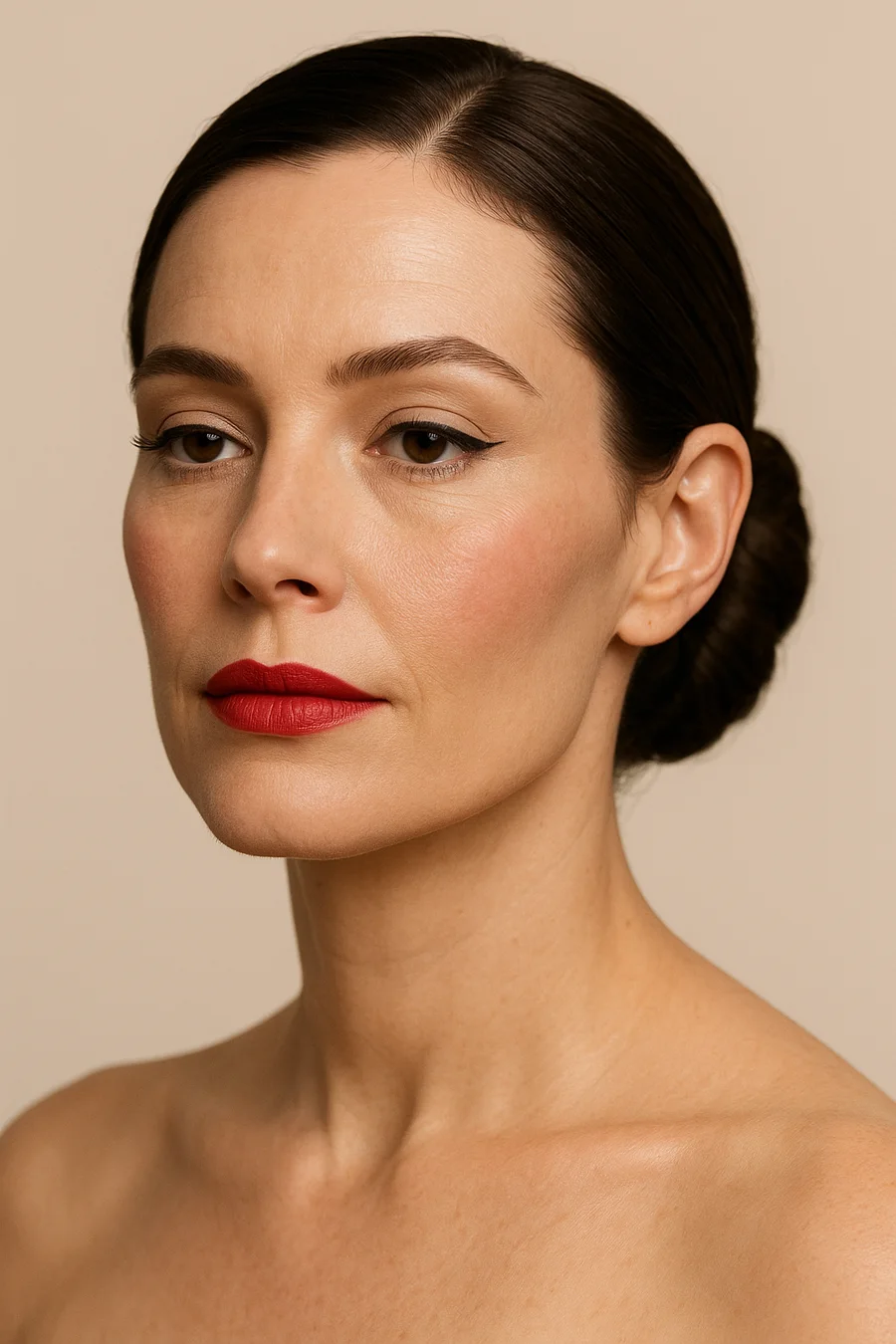
Classic family · Makeup
The Symmetrical Face
Your makeup concept is balance, not statement. Nothing on a Classic face should read as a shape in its own right — not sharply carved, not softly rounded, just evenly blended color that lets your natural symmetry carry the look. Muted tones and a seamless finish are the whole idea; the makeup should support the face rather than reshape it.
That restraint matches everything else about you. Kibbe pitches the Classic line as the system’s center of gravity — even, considered, never reaching for extremes — and a face that’s been contoured, smoked out, or built up in bold color works against that balance rather than for it. The most flattering version of your face is the one that still looks unmistakably like your face, just quietly polished.
How to apply the idea
Eyes take muted shadow blended so thoroughly that no single line or edge stands out — a matte finish throughout, with eyeliner kept soft and smudged rather than sharply drawn. The effect you’re after is depth without definition: color that deepens the eye rather than outlining it. On the cheek, keep blush moderate to soft, placed along the lower curve of the cheekbone and blended out until it disappears into the skin — there should be no visible starting or stopping point. Lips take a moderate, clean application: enough color to look finished, applied crisply enough that the mouth reads as neat rather than heavy. Across all three, the test is the same — if you can point to exactly where the color begins or ends, blend it further.
Your colors
Kibbe sorts palettes into four groups by undertone and contrast — Groups I and II run cool, Groups III and IV run warm. Find the group nearest your own coloring and use the eyeshadow trio (lid, orbital bone, highlighter) alongside the matching blush and lip shade below. The formula stays constant across all four: a mid-depth lid color, a slightly deeper orbital shade to soften the crease, and a light highlighter to keep the whole eye from going flat. Only the specific hues shift group to group.
| Group I — Contrast / Winter | |||
|---|---|---|---|
| Eyeshadow (lid / orbital / highlighter) | Blush | Lips | |
| 1 | Navy / Medium Fuchsia / Light Lavender | Deep Rose to Soft Cranberry | Deep Raspberry to Soft Cranberry |
| 2 | Royal Purple / Smoky Purple / Light Pink | Scarlet | Scarlet |
| 3 | Charcoal / Medium Cobalt / Medium Pink | Soft Fuchsia | Soft Fuchsia to Hot Pink (frosted) |
| Group II — Dusty / Summer | |||
|---|---|---|---|
| Eyeshadow (lid / orbital / highlighter) | Blush | Lips | |
| 1 | Smoky Purple / Muted Fuchsia / Lavender | Rose | Soft Rose |
| 2 | Dusty Navy / Periwinkle / Medium Pink | Rosy Red | Rosy Red |
| 3 | Blue-Gray / Mauve / Light Pink | Soft Pink | Soft Pink (frosted) |
| Group III — Rich / Autumn | |||
|---|---|---|---|
| Eyeshadow (lid / orbital / highlighter) | Blush | Lips | |
| 1 | Chestnut / Soft Copper / Soft Yellow | Terra Cotta to Vivid Peach | Terra Cotta |
| 2 | Olive / Khaki / Mustard | Brick Red | Tomato Red |
| 3 | Teal / Turquoise / Apricot | Soft Copper to Muted Bronze | Soft Copper (frosted) |
| Group IV — Vibrant / Spring | |||
|---|---|---|---|
| Eyeshadow (lid / orbital / highlighter) | Blush | Lips | |
| 1 | Jade / Khaki / Yellow | Peach | Peach |
| 2 | Honey Brown / Tan / Soft Peach | Clear Red | Clear Red |
| 3 | Teal Blue / Soft Turquoise / Apricot | Salmon Pink | Soft Coral Pink (frosted) |
Keep eyeliner in the same family as the lid color, just a shade deeper, and stick to matte finishes — this isn’t a face built for sparkle, though a sheer iridescent powder (silver if you’re cool-toned, gold if you’re warm) is fair game for evening. Lipstick reads best matte, with lighter shades naturally carrying a bit more frost; if a red runs too intense, soften it with a light gloss layer rather than switching shades.
Avoid
Anything that turns your face into a statement rather than a balance works against the whole concept. That cuts both ways: an elaborately built, ornate face fights your symmetry as much as a heavily contoured, dramatic one does — and going without any color at all leaves the face looking unfinished rather than natural.
- An overly ornate or elaborately done face.
- Overly dark or heavily contoured makeup.
- A bare, “no makeup” look.
Want the full picture? Take the quiz to confirm your type, or head back to the Classic hub.
Unofficial guide inspired by the Image Identity system in David Kibbe’s Metamorphosis (1987). Body types describe line, not worth — every type is the goal, not a consolation prize.